
Why we print the batch number on the back
It costs us nothing and it has settled four arguments in three years. Here is what it actually solves.
4 min read
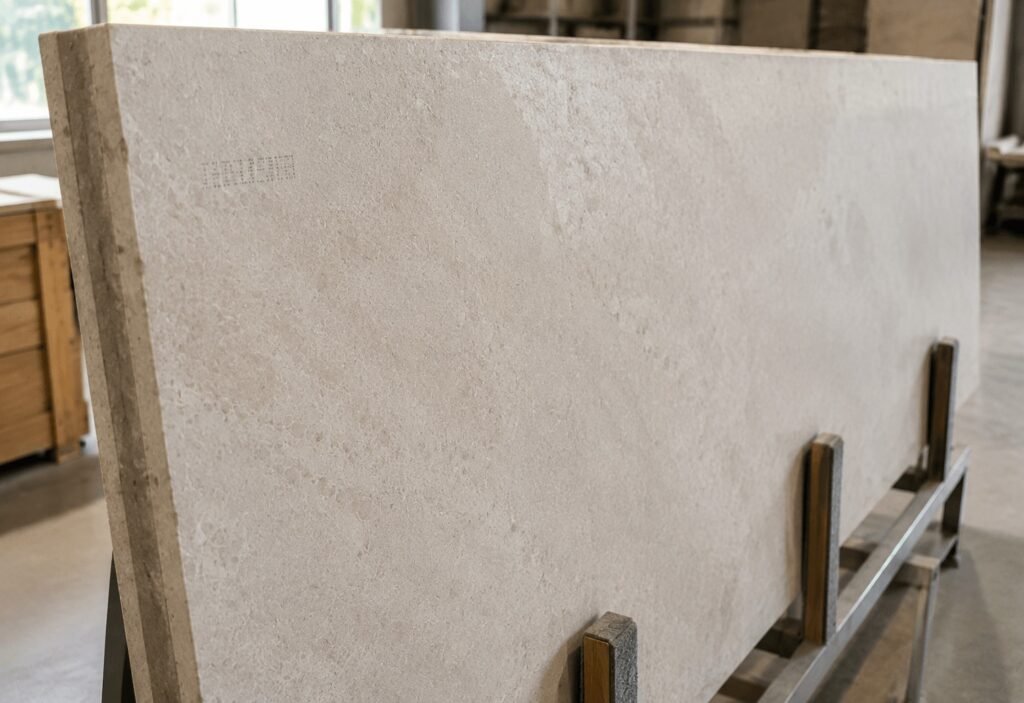
Every slab that leaves Vila-real has a batch code stamped on the unglazed back face. It is not a serial number and it does not identify your project. It identifies the firing: the day, the line and the recipe run that produced that slab.
This costs us almost nothing and it has settled four arguments in three years, so it is worth explaining what it is for.
The problem it solves
Colour in a fired material comes out of a recipe and a kiln curve. Both are controlled, and both drift — not much, and not visibly within a run, but a slab fired in March and a slab fired in November are not guaranteed to be identical. On a 40 m² kitchen this never matters. On 1 900 m² of hotel corridor delivered in four phases across eight months, it can.
The usual way this goes wrong is not dramatic. Phase one is installed and looks right. Phase three arrives, is installed next to it, and someone standing in the corridor at four in the afternoon says the new section looks slightly warmer. At that point there is no way to establish whether it is the material, the lighting, or the fact that phase one has been cleaned two hundred times.
What the code lets you do
With a batch code on the back, three things become possible. The fabricator can sort slabs by firing before cutting, rather than after. The contractor can request that a phased delivery comes from one batch, and we can say yes or no honestly rather than optimistically. And if a comparison does need to be made later, it is a matter of reading two codes instead of comparing memories.
None of this makes the material better. It makes the conversation about the material shorter, and on a large project that is most of the value.
More from the journal
Other notes in the same part of the process.
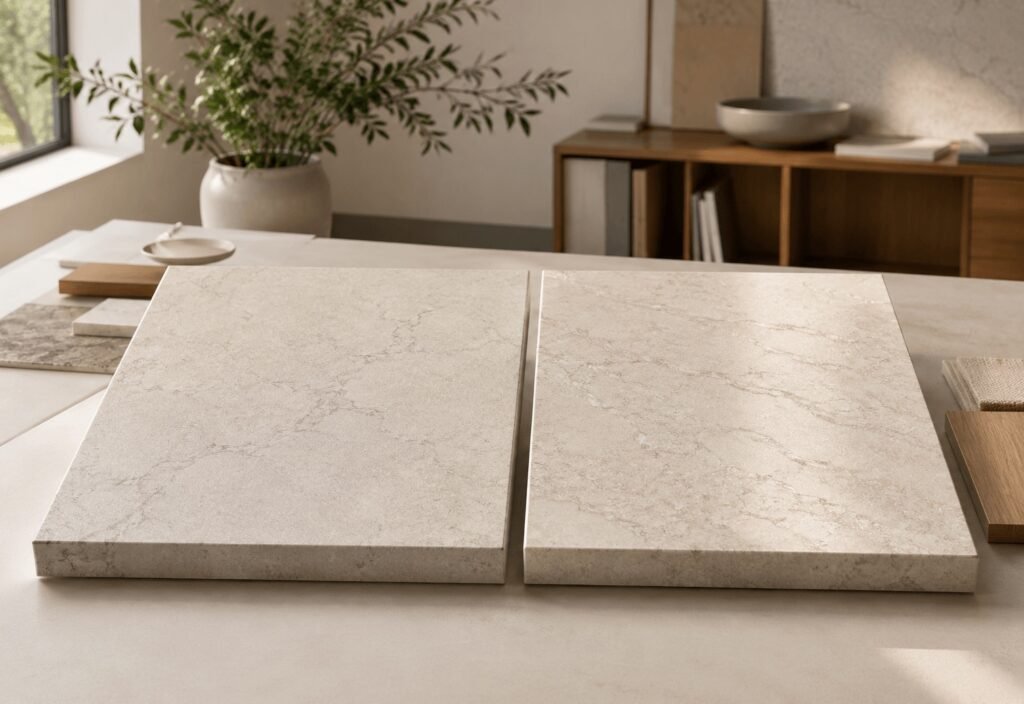
Samples say more than a photograph.
Six finishes, 200 × 200 mm, shipped flat with the technical file in the box.
Sintered stone and engineered quartz surfaces, pressed and fired in Castellón for architects and fabricators in Europe and North America.
Camí Vell 118, 12540 Vila-real, Castellón, Spain
+34 964 000 000 · hello@ardesasurfaces.example
© 2026 Ardesa Surfaces S.L. · Established 2009 · CE marked — sample statement, verify before publishing