
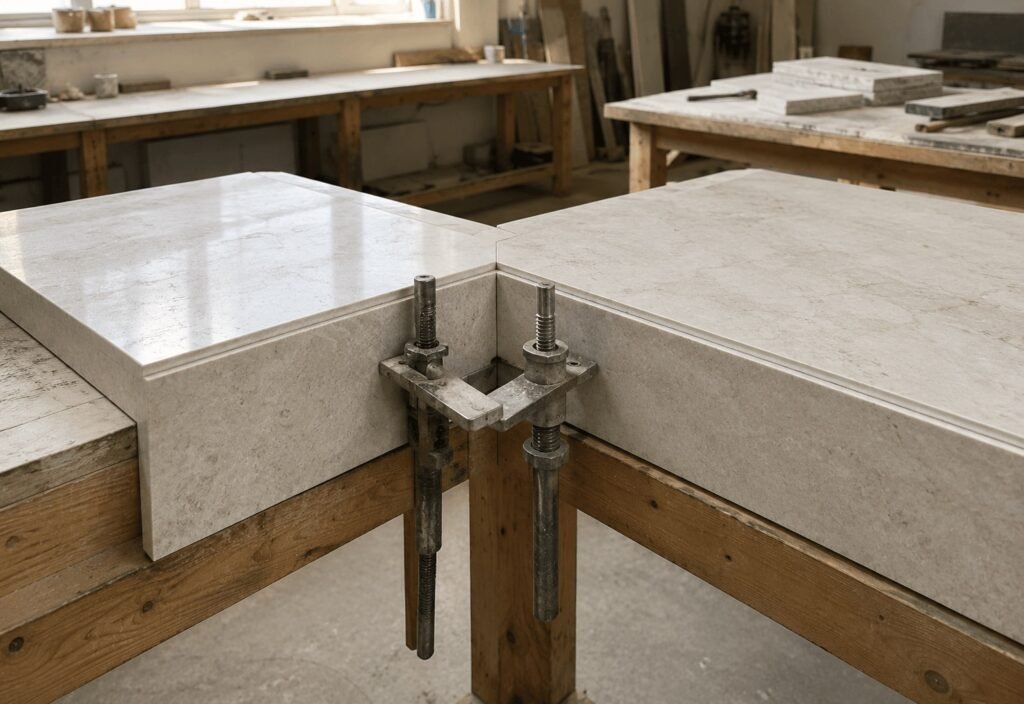
A mitred edge is how a 12 mm slab becomes a 60 mm worktop edge without showing a laminated line. Done well it is invisible. Done badly it is the first thing anyone sees, and it is almost always the first thing the client photographs.
In our experience the mitre itself — the 45 degree cut, the glue, the clamping — is rarely where projects fail. Fabricators who do this every week are good at it. What fails is the decision that was made three weeks earlier.
One: the vein was not set out
On a veined finish the vein has to run over the corner, which means the two faces have to be cut from adjacent material in the right order and the right orientation. That is a setting-out decision made on the slab, ideally with the fabricator marking it up. If the drawing says “mitred edge” and nothing else, the fabricator will cut for yield, and yield and vein continuity are not the same objective.
Two: the substrate was assumed
A mitred edge is a hollow box. What is inside it — a batten frame, a plywood core, or nothing — decides how it behaves when someone leans on the front edge with both hands. This belongs on the drawing. It usually is not.
Three: the tolerance was never agreed
Two cut edges meeting at 45 degrees produce an arris that is, at best, a very fine line. On a dark polished finish that line is visible at 400 mm. On a matt light finish it is not. Whether that is acceptable is a conversation to have with a sample in hand before the worktop is made, not after.
The pattern in all three is the same: the mitre is a fabrication operation, but the quality of it is decided at specification stage.
More from the journal
Other notes in the same part of the process.
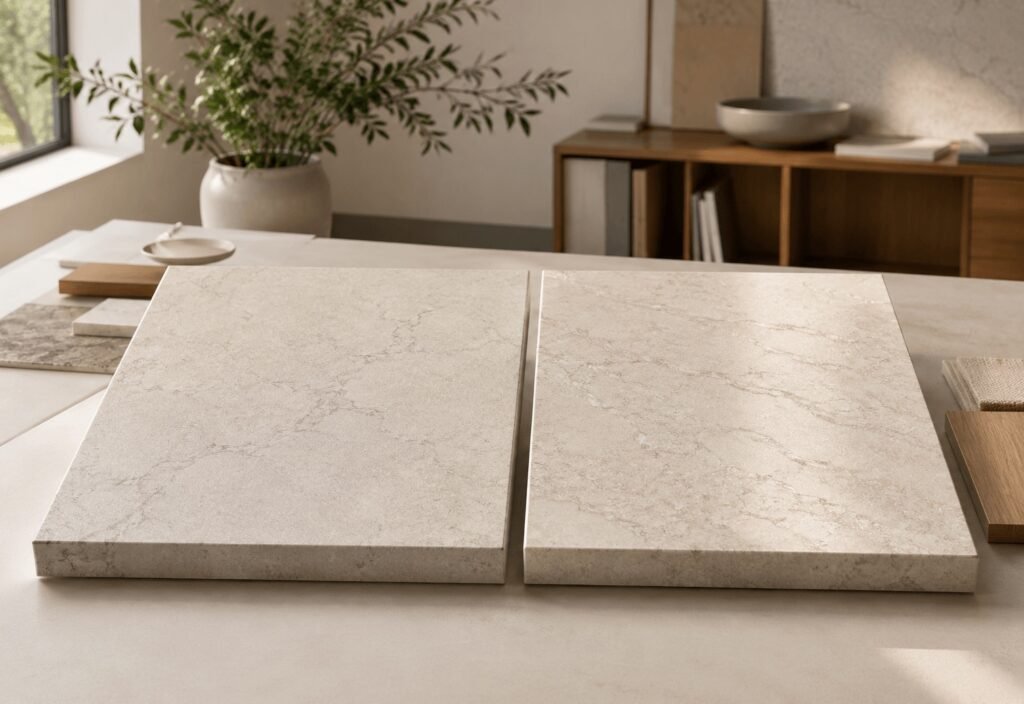
Samples say more than a photograph.
Six finishes, 200 × 200 mm, shipped flat with the technical file in the box.
Sintered stone and engineered quartz surfaces, pressed and fired in Castellón for architects and fabricators in Europe and North America.
Camí Vell 118, 12540 Vila-real, Castellón, Spain
+34 964 000 000 · hello@ardesasurfaces.example
© 2026 Ardesa Surfaces S.L. · Established 2009 · CE marked — sample statement, verify before publishing